
Depression Rehab Centre in India

Depression doesn’t have to dim your days. Abhasa’s therapies and serene spaces help you rediscover balance, hope, and joy.
Private consultation. No pressure.
2:1 Staff-to-client ratio
3 Healing Spaces
Personalised Treatments
360° Healing
2:1 Staff-to-client ratio
3 Healing Spaces
Personalised Treatments
360° Healing
Gallery
Luxury Depression Rehabilitation in India

Find Hope and Healing at India’s Leading Luxurious Depression Rehab Centre
When life feels like it has stopped moving when nothing brings joy, and even basic routines feel like mountains, it may be time to consider depression rehabilitation.[1] This isn’t just about low moods or difficult weeks. This is about the kind of pain that lingers quietly for months or even years.
You might be dealing with a kind of depression that doesn’t look the way people expect.
Some feel nothing at all, completely numb.
Some feel too much, waves of sadness, anger, or guilt they can’t explain.
For some, it hides behind perfectionism. For others, it shows up as burnout, isolation, or unexplained health issues.
And if you’ve tried therapy, taken medication support, or waited patiently, hoping things will lift, but nothing really changes, please know you’re not alone. Many people in pain keep pushing through, believing it’s not “bad enough” to seek more help.[2] But deep down, you may already know this isn’t something you can manage alone anymore. When it reaches that point, depression rehabilitation becomes more than helpful. It becomes necessary. That is where a trusted depression rehab centre can make all the difference.
At Abhasa, we offer more than treatment. We provide a complete reset.[3] A structured, deeply personalised space where your nervous system can calm down. Where your emotions are allowed to breathe. Where you’re not expected to “be okay” all the time.
Our team gently guides you through a rhythm of care, combining therapy, rest, nutrition, movement, and inner work. Every part of our environment is designed to help you return to life slowly, steadily, and safely. This is your turning point.
Understanding Depression Rehabilitation and the Path to Recovery
Depression can affect every part of life: how you think, how you feel, and how you show up in the world. It is not just sadness or tiredness. It is a quiet weight that can make daily tasks overwhelming or even impossible. When this happens, simply “pushing through” often does not work. That is when depression rehabilitation becomes a vital and compassionate part of the healing journey.
What does depression rehabilitation mean for someone living with it?
At its heart, rehabilitation for depression is about helping a person slowly reconnect with life. It is not only about treating symptoms. It is about guiding someone back to themselves with care and patience.
Through a supportive routine, emotional guidance, movement, rest, nutrition, and self-expression, people are given the space to feel again, grow again, and come back to life at their own pace.[4] A trusted rehab centre for depression provides the calm, care, and clarity that home or outpatient therapy may not always be able to offer.
Healing Is Personal
Depression rehabilitation is not limited to therapy or medication support alone.[4,5] It is a structured yet nurturing process that may include individual counselling, group therapy, mindful movement, nutrition support, daily routines, and creative or holistic healing practices. We tailor-make a full-circle approach to support depression recovery by seeing the whole person, not just their symptoms.
A quality rehab for depression offers more than treatment. It gives people the time, space, and guidance to start feeling again.[3] It helps them break free from isolation, rediscover moments of joy, and slowly rebuild trust in themselves and others. Most importantly, it gives caregivers and families the tools and understanding to support the healing process with clarity and compassion.
At Abhasa, we have seen how transformative the right depression treatment environment can be. We’ve seen how recovery is more personal, powerful, and lasting in a serene space.
If you or someone you love has been struggling with depression, know that you are not alone. And you do not have to carry it alone.
Depression rehabilitation is not a last resort. It is a meaningful beginning. A chance to come home to yourself with support at every step.
What does depression rehabilitation mean for someone living with it?
At its heart, rehabilitation for depression is about helping a person slowly reconnect with life. It is not only about treating symptoms. It is about guiding someone back to themselves with care and patience.
Through a supportive routine, emotional guidance, movement, rest, nutrition, and self-expression, people are given the space to feel again, grow again, and come back to life at their own pace.[4] A trusted rehab centre for depression provides the calm, care, and clarity that home or outpatient therapy may not always be able to offer.
Healing Is Personal
Depression rehabilitation is not limited to therapy or medication support alone.[4,5] It is a structured yet nurturing process that may include individual counselling, group therapy, mindful movement, nutrition support, daily routines, and creative or holistic healing practices. We tailor-make a full-circle approach to support depression recovery by seeing the whole person, not just their symptoms.
A quality rehab for depression offers more than treatment. It gives people the time, space, and guidance to start feeling again.[3] It helps them break free from isolation, rediscover moments of joy, and slowly rebuild trust in themselves and others. Most importantly, it gives caregivers and families the tools and understanding to support the healing process with clarity and compassion.
At Abhasa, we have seen how transformative the right depression treatment environment can be. We’ve seen how recovery is more personal, powerful, and lasting in a serene space.
If you or someone you love has been struggling with depression, know that you are not alone. And you do not have to carry it alone.
Depression rehabilitation is not a last resort. It is a meaningful beginning. A chance to come home to yourself with support at every step.
Depression rehab that empowers you, one step at a time.
Why Choose Depression Rehabilitation for Lasting Recovery

Healing That Goes Beyond the Surface
Some struggles are loud. Depression is not. It often creeps in quietly through low energy, sleepless nights, and a growing disconnection from the people and things that once mattered. It can leave you feeling stuck as if life is happening around you but not with you. Getting through the day may feel more like surviving than truly living.
When left unaddressed, depression can intensify. It can affect your physical health, work, relationships, and identity.[1,2] Over time, it may feel like you are carrying a heavy weight no one else can see. And even when you are ready for help, the real fear begins when you cannot figure out where to start.
That is where a depression rehab facility can make all the difference. Choosing rehabilitation for depression is not just about getting help. It is about creating deep, lasting healing conditions in a space that prioritises clinical care and emotional safety.
A structured depression rehabilitation program gives you the space to pause, reflect, and begin again with intention. It helps you step away from chaos and exhaustion and gently return to yourself with clarity and purpose. In this kind of setting, healing becomes both possible and deeply personal.

Benefits of Depression Rehab You Should Know
The benefits of depression rehab extend far beyond short-term symptom relief. A high-quality rehab environment helps you:
- Experience structured living that brings stability and predictability to each day.[3]
- Receive expert guidance from licensed mental health professionals and specialists.
- Access round-the-clock support to ensure emotional and physical safety
- Engage in various therapeutic practices, including counselling, group therapy, mindfulness, and movement-based therapies.[4,5]
- Find emotional healing in a safe setting where you are never judged and always supported.
In addition, a well-designed rehabilitation centre for depression helps improve sleep, regulate nutrition, manage stress, and rebuild healthy thought patterns. You gain real-world tools to deal with triggers, reduce emotional burnout, and reconnect with life on your terms.
Avoiding treatment can make recovery more difficult. Untreated depression can lead to long-term emotional strain, physical illness, or fractured relationships. The longer it remains hidden, the more deeply it can take hold.
But you do not have to wait for things to get worse. You do not need to reach a breaking point to seek help. Choosing a rehab centre for depression is not a sign of weakness. It is an act of courage.
If a part of you quietly says, “I cannot do this alone anymore,” that voice deserves to be heard. And supported.
Why Families Trust Abhasa - A Leading Depression Rehab Facility in India
It starts with how we make you feel
When families reach out to us, they often carry silent burdens such as worry, helplessness, and years of trying to hold things together. At Abhasa, we meet them with compassion, not judgment. The moment they step in, they feel the difference. This is not just another facility. It is a space where every question is welcome, every emotion is heard, and hope slowly begins to return.
That emotional connection is why many consider Abhasa among the best depression rehab centres in the country. Because our care is not just clinical, it is deeply human.
We build care around your loved one, not the other way around
No two people experience depression the same way. For some, it is quiet withdrawal. For others, it is exhaustion, irritability, or complete emotional shutdown.
That is why we do not follow a standard protocol.
At our luxury depression rehab, every recovery plan is custom-designed, from therapy choices to lifestyle rhythms. Our team continuously observes and adjusts based on how each person responds emotionally and physically.
We listen closely. We make changes when needed. This kind of individualised attention builds absolute trust and real progress.
We help you understand, not just cope
It is hard to support someone with depression when you do not understand what they are going through. At Abhasa, we walk alongside families with information, tools, and emotional insight.[6]
We explain what depression does to the mind and body. We help you recognise patterns and triggers and show you how to support healing without pressure.
That is where our strength lies, not just in offering care but in helping families feel confident and clear about what healing means.
We blend ancient wisdom with modern science
Abhasa is not a clinical institution with cold walls. It is a peaceful haven where modern psychology meets ancient healing.
Alongside proven therapies like CBT, DBT, and trauma-informed care, we offer movement practices, nature immersion, art expression, homa therapy, yoga, and gentle bodywork.[4,7] This happens in a serene, natural environment that feels safe and restorative.
Families often tell us that it does not feel like a rehab. It feels like a luxury depression rehab designed for deep, meaningful healing.
24/7 Safety, privacy, and support
We know how much it matters for your loved one to feel safe and cared for. At Abhasa, we offer round-the-clock clinical and emotional support, spacious private rooms, wellness therapies, and a staff-to-client ratio that ensures no one is left behind.
Everything we do, from daily routines to personalised check-ins, is done with intention.
This is why families across India and beyond choose Abhasa when searching for the best depression rehab centres for long-term recovery and emotional safety.
Families trust care that truly listens
Meet Our Experts in Depression Care
At Abhasa, recovery happens best when people feel safe, understood, and supported. That is why our team is handpicked for their clinical excellence, compassion, and approachability.
Each care team member brings their own depth of experience in mental health and wellness. They come together to create the warm and structured environment that makes Abhasa a trusted depression rehabilitation centre in India.
From psychiatrists and clinical psychologists to holistic therapists and wellness coaches, every expert here plays a role in delivering truly holistic depression treatment.[4,5]

Dr. Naveen Kumar
Medical Director
15+ years of expertise in psychiatry and addiction recovery.

Dr. Vivek Sharma
Consultant Psychiatrist & Neurofeedback Practitioner
With over 15+ years of experience in psychiatry and neurofeedback, he blends medical expertise and compassion to guide clients toward lasting recovery.

Dr. Shree Aarthi
Consultant Psychiatrist
15+ years providing expert psychiatric care for mental health and substance use disorders.

Dr. Ramalingam P Kandaswamy
Consultant Physician
15+ years With over 5 years of experience in HIV and infectious diseases, he brings global expertise and compassionate care to every patient he supports.

Dr. Divya
Psychiatrist
10+ years combining clinical psychiatry expertise with healthcare management for holistic treatment.

Dr. Malarvilzhi
Residential Medical Officer
12 years delivering comprehensive medical care in psychiatric and rehabilitation settings.

Dr. Karuppachamy
Senior Psychiatric Social Worker
22+ years of experience empowering clients through therapeutic guidance, psychosocial support, and lived-experience wisdom.

Ms. Meera
Senior Clinical Psychologist
9+ years specializing in psychological assessment and evidence-based therapeutic interventions.

Mrs. Priyadarshini
Head Clinical Psychologist

Mr. Mukesh Kanna
Clinical Psychologist
2+ years providing psychological interventions for behavioral health and emotional wellness.

Mr. Antipas Jayabal
Clinical Psychologist
2+ years supporting clients through clinical assessment and therapeutic care.

Ms Keerthana S
Psychologist
Empathetic psychologist with 4 years’ experience in handling mental health disorders, using evidence-based psychotherapies for personalized client care.
Inside Our Residential Rehab for Depression
Not all recovery spaces feel the same
If you imagine a residential rehab for depression as a place where people are just medicated and left alone, you are not the only one. That is a common image. But the reality in Abhasa looks very different.
Here, healing is not limited to managing symptoms. It is about rebuilding life gently and thoroughly.
In our private depression rehabilitation centre, we integrate care, structured living routines, and support in a way that fosters both healing and transformation.
We go step by step, with care.
Step 1: Understanding the root cause before anything else
We do not rush into action. We begin with understanding.
Our process starts with a series of personalised evaluations:
- Psychological assessments to explore thought patterns, emotional triggers, and stress responses.
- Clinical reviews from our psychiatrists and psychologists work together to shape a plan based on symptoms and the whole emotional picture.
- Lifestyle mapping to observe sleep, nutrition, social connection, and routine challenges.
This kind of deep listening and observation is often what families say sets us apart from other rehabilitation centres for depression.
Step 2: Building a personalised plan that grows with you
There is no fixed formula here. Every recovery plan at Abhasa evolves with the person.
Our clinical team reviews progress weekly and makes necessary adjustments based on emotional, physical, and behavioural responses. This flexibility allows us to support healing in a way that respects rhythm and readiness.
We are known for being one of the best depression rehab centres because of this personalised, layered approach.
Step 3: Healing through layered support
At our private depression rehabilitation centre, we approach healing in multiple layers. Here’s what that includes:
- Mind-body practices like yoga, mindful movement, and expressive arts[7,8]
- One-on-one therapy that is not limited by time constraints
- Group sessions that encourage healthy connection and trust[9]
- Nutritional support tailored to energy levels and mood balance
- A daily structure that helps bring back a sense of normalcy and control
- Recreation and nature that gently reintroduce joy and curiosity
- Coping skills training to manage complex thoughts and emotional patterns[4]
Most importantly, each activity is introduced at the right time. No one is forced. We go step by step, with care.
A program that respects privacy and dignity
Abhasa does not look or feel like a hospital. Clients live in peaceful private rooms surrounded by greenery and silence. Every detail, from food to therapy timing, is chosen to restore ease.
As a luxury depression rehab, our space is designed for healing with dignity, privacy, and quiet strength. Families are not left outside the process. We keep them informed, involved, and supported throughout the journey. This level of family involvement in rehab helps ensure long-term recovery.[6]
If you are looking for a place that combines medical excellence with emotional intelligence, our residential rehab for depression program may be what you have been searching for.
A Typical Day at Abhasa: Structure, Serenity, and Support

Why rhythm matters in depression recovery
When someone is living with depression, their inner world can often feel unpredictable. Mood, energy, and motivation may shift without warning. That is why we focus so deeply on establishing a predictable and nurturing structured living routine at Abhasa.[3] It is not just about keeping time. It is about creating emotional safety through rhythm.
Each day at our residential rehab for depression is thoughtfully planned to support body regulation, emotional clarity, and mental ease. Our environment offers a sense of stability that many people struggling with depression have been missing.
This is not just treatment. It is retraining the brain to feel safe again.
Morning: Calm, Ground, and Energise
Mornings at Abhasa begin gently. Clients wake to a calm environment, easing into the day with:
- Homa therapy or guided breathwork
- Herbal detox drinks
- Gentle body movement like yoga or walks in nature
This early rhythm prepares the nervous system to handle emotional work and starts the day with purpose. A wholesome breakfast follows, often shared in peaceful garden spaces.
Mindful practices like guided meditation and journaling set the emotional tone for the day. These routines, supported by neuroscience, are foundational to healing in a depression rehab facility.
Midday: Deep Work and Expression
By midday, clients begin the deeper emotional and psychological sessions. This includes:
- Personal therapy and progress reviews
- Group therapy and peer circles
- Coping skills training to manage thoughts, triggers, and overwhelm
- Pathway to Wellness: sessions on emotional literacy and real-world readiness
- Creative therapies like painting, music, aroma therapy, movement, and more
These sessions are paced based on each client’s comfort. Our team ensures emotional safety throughout, helping clients engage without feeling overwhelmed.
This balanced blend of structure and expression is one reason families trust us as a leading rehabilitation center for depression and anxiety.
Evening: Rest, Reflect, and Reset
Afternoons transition into lighter activities. Clients participate in recreational time, outdoor games, or fitness sessions. They are also encouraged to enjoy quiet personal time before dinner.
Evenings are screen-free and slow-paced, ending with:
- Warm meals
- Reflection circles
- Gratitude journaling or mindfulness
These practices are part of our commitment to holistic depression treatment. A gentle wind-down helps regulate sleep and build consistency in mood.
The Power of Structure in Depression Healing
Many who come to us feel emotionally scattered. Their routines are often disrupted by long periods of inactivity, insomnia, or emotional shutdown. What they need is rhythm, not rigidity.
That is why our entire program, at one of the best depression rehab centers in India, is built around structured care. From meals to movement, from therapy to downtime, each part of the day is intentional.
At Abhasa, we do not just fill time. We use it to build trust, clarity, and inner strength.
Whether you are looking for a luxury depression rehab or a deeply human one, our daily rhythm reflects both. We offer a supportive environment where each hour moves the healing forward.
Personalised Depression Treatment That Truly Fits You
Many people walk into a treatment program already guarded, already tired. That’s why, unlike many schizophrenia residential treatment centres, we never hand over a fixed plan and walk away. We let the plan breathe. And we build it with them.
Depression affects everyone differently. For some, it feels like a quiet, constant fatigue. For others, it shows up as racing thoughts, chronic anxiety, or an overwhelming sense of numbness. That is why a personalised approach to depression treatment rehabilitation is at the core of what we do at Abhasa. Healing should feel like it belongs to you, not like a one-size-fits-all solution.
Many traditional programs rely on rigid routines and generic protocols. Most structured programs provide a framework, but they often miss the heart of healing. Many programmes overlook the deeper layers of a person’s experience, such as their background, emotional history, or how their culture influences their worldview. When care doesn’t account for these things, it can feel distant and impersonal. That kind of distance makes healing harder. People may begin to feel like no one sees them.
At Abhasa, we approach things in a different way. We don’t assume. We ask, we listen, and we learn. From the very first conversation, we aim to understand your life as a whole, not just what you’re struggling with, but also why you’re struggling, what matters to you, and what has shaped your journey so far. We use that understanding to build support that feels right for you.
True healing starts when someone feels fully seen. That’s where we begin. This insight becomes the foundation for a customised plan that evolves with you over time.
What sets us apart from other depression residential treatment centres is our ability to adapt your care. Your plan may combine evidence-based therapies, mindfulness practices, trauma-focused healing, medication when appropriate, movement therapy, creative expression, and practical life skills development. Every element is carefully chosen and adjusted to match your pace of recovery.[4,5]
Healing is never a straight line. Some days may feel steady, others may not. That is normal, and we honour that. Our team adjusts your care to meet you where you are, whether that means slowing down or shifting modalities. Every step is guided by your long-term well-being.
We also believe that involving your support system matters. With your consent, we include family in your journey. Through education, guided sessions, and emotional support, we help build stronger relationships and provide tools for ongoing healing beyond your stay.[6]
This is the difference between standard care and personalised care. Your recovery at Abhasa is not dictated by rigid systems, but shaped with compassion, insight, and genuine respect for your experience.
At Abhasa, we do more than help you manage depression. We help you uncover the life waiting beneath it.
If you are looking for a depression rehab centre that honours your individuality and supports you with flexible, thoughtful care, we are here to walk with you.

Healing That Includes Everyone: Personalised Depression Care at Abhasa




At Abhasa, we believe depression recovery should never feel isolating. Healing is more effective when it happens in a supportive environment that considers the whole person, their story, their needs, and their relationships. That is why family involvement in rehab is a key part of how we approach care.
Many traditional programs focus solely on the individual and their symptoms. Often overlooking the significant role that loved ones can play in the healing process. But support systems matter. When family members are included, educated, and guided, they become a source of strength, not stress. The connection helps rebuild trust, improve communication, and create a stable foundation that supports recovery long after the program ends.[6]
At Abhasa, we take time to understand each person beyond their symptoms. Our team considers the whole picture, including your emotional world, your pace, past experiences, and the relationships that shape your life. From there, we create an individualised treatment plan that adapts as you grow.
We also offer resources and support for families, including counselling, workshops, and check-ins that help loved ones feel informed, involved, and supported throughout the journey. This is where the fundamental transformation happens; not just within the individual, but across the whole family system.
Our rehab program for depression combines evidence-based therapy, holistic practices, creative expression, and practical life skills. Every element is designed to meet you where you are and move with you as you progress in your recovery. Whether it is movement therapy, mindfulness, or learning coping skills for daily life, you are surrounded by people who understand and care.
Our Healing Environment & Amenities
At Abhasa, healing begins with where you are. That is why every inch of our campuses in Coimbatore and Karjat is intentionally designed to create calm, encourage reflection, and support emotional balance. As a leading luxury depression rehab centre in India, we believe the environment plays a vital role in shaping recovery. At Abhasa, healing often begins in the quiet moments, under a tree, along a garden path, or while listening to the soft sound of birds in the morning. These aren’t just peaceful details. They help you feel grounded, steady, and safe. Nature has a way of holding space for reflection when words fall short.
Step inside, and the feeling continues. Our therapy spaces feel more like home than a clinic. Sunlight fills the rooms, softening the space and helping you feel at ease. Nothing is harsh or sterile here, just warmth, calm, and quiet support. Every corner is designed to help you settle in, open up, and feel safe enough to share what’s on your heart. This kind of environment allows real healing to begin, gently and without pressure, at the pace that feels right for you. Each space invites you to slow down, settle in, and be present with your thoughts.
Creative expression is another core element of healing at Abhasa. Our on-site art studio gives clients space to explore emotions through colour, texture, and movement.
The yoga deck offers an open view of the sky, enveloped in vibrant greenery that enhances breathwork and encourages gentle movements. Each session aims to help you reconnect with your body, alleviate tension, and foster resilience. Close by, our spa features soothing treatments like massages and Ayurvedic therapies that soothe the body and relax the mind.
Together, these spaces create a sense of peace, and you will receive the right kind of support for your healing. What makes Abhasa feel different isn’t just the care we offer; it’s the peaceful setting that wraps around every part of your journey and sets Abhasa apart as a luxury depression rehab destination.
Recovery at Abhasa doesn’t stop at the therapy room door. It flows into the gardens, the quiet corners, the soft morning light. Nature plays an active role here, offering comfort, stillness and space to breathe. Every element, from the surroundings to the daily rhythm, is designed to help you feel more grounded as you begin to heal. Our grounds in Coimbatore and Karjat are designed to deliver not only beauty but also deep emotional support, a truly therapeutic environment.
The scenic surroundings immerse you as you step into our centres. The gardens, walkways, and courtyards provide a serene setting for quiet reflection. The intention behind the calming surroundings is to reduce stress and ease anxiety, eventually helping to soothe the nervous system. This is nature-based healing for depression in its most grounded form.
Our therapy spaces are far from cold or clinical. They are a key part of the supportive environment that defines Abhasa, where care is personalised, healing is compassionate, and every interaction is grounded in respect and humanity.
For people who struggle with emotional expression and processing, art therapy at Abhasa is particularly helpful. Trained facilitators integrate expressive arts into our broader holistic approach to treating depression.
Our outdoor yoga deck is situated amid lush greenery and open skies, helping you release all your physical and emotional burdens through calming practices.
These spaces form the heart of our depression recovery retreat. The healing presence of nature softens where structure meets serenity and clinical care. Each touchpoint, from therapy to downtime, is designed to help you reconnect with yourself and move forward with clarity and strength.
At Abhasa, we do more than treat depression. We create an experience where recovery is supported by surroundings that reflect peace, comfort, and care.
Curious how this program can support your loved one?
Stories of Strength: Life After Rehab
Every journey at Abhasa is deeply personal, but some moments of recovery are too powerful not to share. These real stories from our schizophrenia rehab center show what becomes possible when care is consistent, compassionate, and rooted in trust. They highlight how rehabilitation for schizophrenia patients can lead to emotional breakthroughs, restored relationships, and long-term recovery.
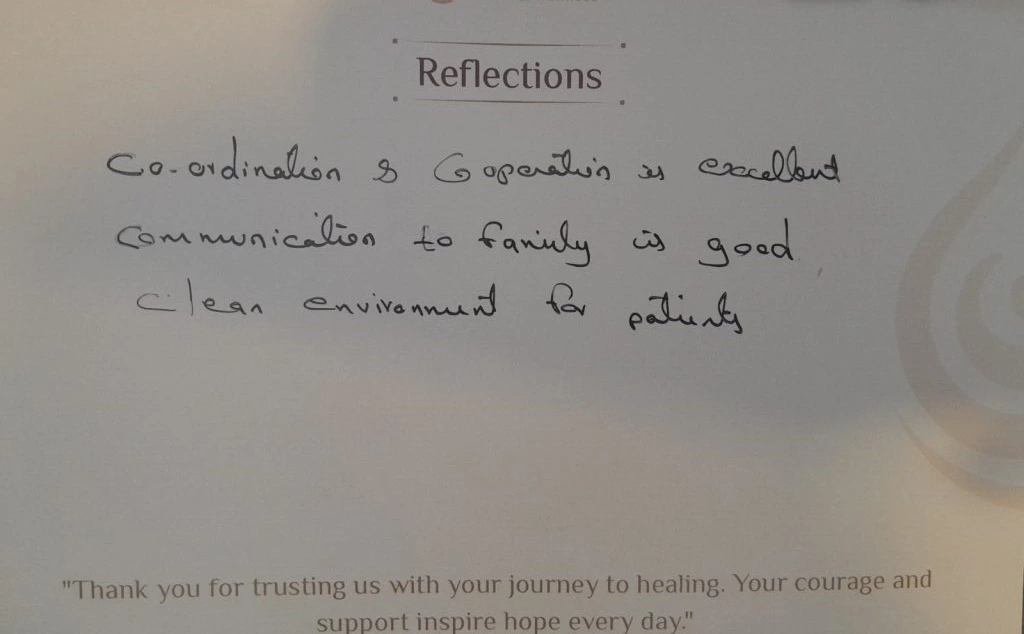
Co-ordination & cooperation is excellent. Communication to family is good. Clean environment for patients.
Former Client
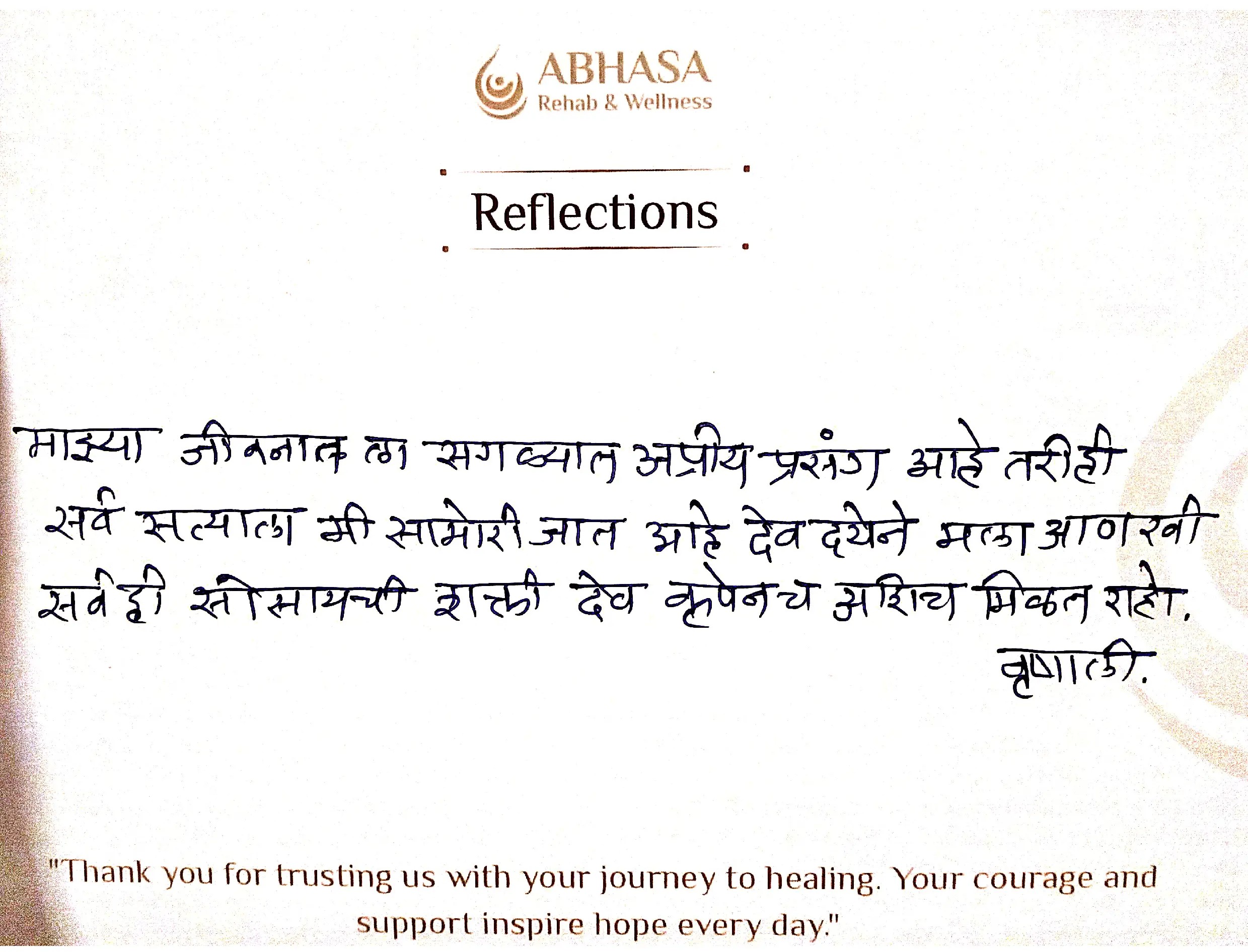
I found strength to face life’s hardest truths here. I believe it was God’s grace that brought me to Abhasa.
Former Client
“no-obligation consultation within 24 hours”
FAQs
What is depression rehabilitation?
Depression rehabilitation is a place that offers comprehensive support for individuals struggling with persistent sadness and fatigue, leading to disconnection from life.[3,4] At Abhasa, we combine evidence-based therapy, structured daily rhythms, and holistic healing to guide recovery in a compassionate, judgment-free space. For those searching for a depression rehab centre near me, our residential approach nurtures both emotional balance and personal strength with complete care that includes therapy, wellness activities, and nature-inspired rest.
Can a depressed person go to rehab?
How long does rehab last for depression?
Does rehabilitation work for depression?
Yes. When done in a nurturing, consistent setting, rehabilitation can offer lasting relief from depressive symptoms.[2,3] Our team comprises therapists, wellness coaches, and support staff who collaborate to address every aspect of distress. Individuals exploring rehab for depression near me often find that healing becomes real only when it’s supported with empathy, insight, and holistic care under one roof.
Can a depressed person live an everyday life after rehab?
Absolutely. Many clients go on to thrive, returning to their careers, rebuilding relationships, and finding peace in everyday life. The key lies in having a recovery plan that includes therapy, community support, and ongoing aftercare.[2] At Abhasa, we design support that lasts beyond discharge. If you’ve searched for a depression rehab centre near me, this may be the first step toward a life that feels meaningful and whole again.
What kind of care is provided at Abhasa Rehab and Wellness?
We offer integrated care that supports the whole self. Clients engage in one-on-one therapy, as well as expressive modalities such as art or journaling, body-based practices like yoga and breathwork, and family sessions to restore connection.[4,7] If you’ve been looking for a depression rehab centre near me, we provide more than a programme; we offer a safe, luxurious setting where people are seen, heard, and supported.
Where can I go to recover from depression in India?
Which therapy approach is best for depression rehabilitation?
There’s no single answer for therapy. At Abhasa, we combine therapies such as CBT, narrative counselling, mindfulness, and holistic methods to tailor each individual’s treatment to the individual’s needs.[4,5] Clients exploring rehab for depression near me benefit most from flexible plans shaped around their emotional patterns, life experiences, and strengths, not generic routines.
Is residential rehab better than outpatient counselling?
For moderate to severe depression, residential care often provides deeper support.[3] Inpatient programmes remove daily stressors and distractions, allowing individuals to focus entirely on healing. While outpatient care suits some, those searching for a depression rehab centre near me often discover that full-time, immersive support is what finally moves the needle toward lasting recovery.
What happens after discharge from depression rehab?
Blog and Expert Resources


Setting Wellness Goals That Actually Stick: A Practical Guide for 2026
Setting Wellness Goals That Actually Stick: A Practical Guide for 2026 Reviewed by: Abhasa Clinical TeamLast Updated: December 2025 Why

New Year Self-Reflection Questions: A Thoughtful Guide to Personal Growth and Mental Wellness
New Year Self-Reflection Questions: A Thoughtful Guide to Personal Growth and Mental Wellness Reviewed by: Abhasa Clinical TeamLast Updated: December

Navigating Family Gatherings When You’re in Recovery or Healing
Navigating Family Gatherings When You’re in Recovery or Healing Reviewed by : Abhasa Clinical TeamLast Updated: November 2025 If you’re
Begin Your Recovery Journey
Discover care that truly sees you at one of the best depression rehab centres.
Proudly Serving Across Cities
- Rehab in Karjat
- Rehab in Pune
- Rehab in Navi Mumbai
- Rehab in Madurai
- Rehab in Trichy
- Rehab in Bangalore
- Rehab in Chennai
- Rehab in Thane
- Rehab in Nasik
- Rehab in Kochi
- Rehab in Mangalore
- Rehab in Mysore
- Rehab in Hyderabad
- Rehab in Vijayawada
- Rehab in Visakhapatnam
- Rehab in Delhi
Medical Disclaimer
This information is for educational purposes only and does not constitute medical advice. Depression is a serious medical condition that requires professional diagnosis and individualized treatment. The information provided about Abhasa’s services, treatment approaches, and potential outcomes should not replace professional medical consultation, diagnosis, or treatment planning.
Individual results vary significantly. The effectiveness of depression rehabilitation depends on multiple factors including severity of symptoms, duration of illness, individual biology, co-occurring conditions, treatment adherence, and personal circumstances. Research cited represents general treatment effectiveness studies and does not guarantee specific outcomes at our facility.
Always consult qualified healthcare professionals before making treatment decisions. If you are considering depression rehabilitation, speak with your primary care physician, psychiatrist, psychologist, or other licensed mental health professional about whether residential treatment is appropriate for your specific situation.
Treatment limitations: Not all individuals achieve remission or full recovery from depression. Some individuals may require ongoing treatment, medication management, or additional interventions beyond residential rehabilitation. Relapse is possible and does not indicate treatment failure.
If you are experiencing a medical or psychiatric emergency, call emergency services immediately (911 in the US) or go to your nearest emergency room. Do not delay seeking emergency care.
RESOURCES
Research Citations (15 Most Authoritative Sources):
[1] World Health Organization – “Depressive disorder (depression)” – WHO Fact Sheet, August 29, 2025
URL: https://www.who.int/news-room/fact-sheets/detail/depression
Source Type: International Health Organization – Tier 1
Supports: Depression prevalence (280+ million globally), treatment effectiveness, global impact
[2] Nature Translational Psychiatry – “Prognosis and improved outcomes in major depression: a review” – April 3, 2019
URL: https://www.nature.com/articles/s41398-019-0460-3
Source Type: Peer-reviewed Medical Journal – Tier 1
Supports: Early treatment importance, outcome predictors, long-term prognosis
[3] BMC Psychiatry – “Effectiveness of inpatient versus outpatient complex treatment programs in depressive disorders” – December 2, 2019
URL: https://bmcpsychiatry.biomedcentral.com/articles/10.1186/s12888-019-2371-5
Source Type: Peer-reviewed Research – Tier 1
Supports: Residential treatment effectiveness (Cohen’s d 1.10-1.76), large effect sizes, 46.9% remission rates
[4] PMC – “Major depressive disorder: Validated treatments and future challenges” – 2021
URL: https://pmc.ncbi.nlm.nih.gov/articles/PMC8610877/
Source Type: Peer-reviewed Research – Tier 1
Supports: Evidence-based treatment validation (CBT, IPT, pharmacotherapy), comprehensive treatment approaches
[5] APA – “Guideline for the Treatment of Depression” – Clinical Guidelines
URL: https://www.apa.org/depression-guideline/guideline.pdf
Source Type: American Psychological Association – Tier 1
Supports: Evidence-based treatment standards, psychotherapy effectiveness, professional practice guidelines
[6] Wiley Online Library – “Family involvement in psychotherapy for depression in children and adolescents” – March 14, 2022
URL: https://bpspsychub.onlinelibrary.wiley.com/doi/10.1111/papt.12392
Source Type: Meta-analysis (19 RCTs, N=1553) – Tier 1
Supports: Family involvement effectiveness (effect size d=0.34), improved treatment outcomes
[7] Frontiers in Psychology – “Meta-analysis of mindfulness yoga exercise intervention on depression” – November 16, 2023
URL: https://www.frontiersin.org/journals/psychology/articles/10.3389/fpsyg.2023.1283172/full
Source Type: Meta-analysis (22 studies, N=2,216) – Tier 1
Supports: Mindfulness yoga effectiveness for depression, mind-body interventions
[8] AAFP – “Depression and Anxiety Disorders: Benefits of Exercise, Yoga, and Meditation” – May 15, 2019
URL: https://www.aafp.org/pubs/afp/issues/2019/0515/p620.html
Source Type: American Academy of Family Physicians – Tier 1
Supports: Yoga as monotherapy or adjunctive treatment, mindfulness-based interventions
[9] PMC – “Efficacy of Peer Support Interventions for Depression: A Meta-Analysis”
URL: https://pmc.ncbi.nlm.nih.gov/articles/PMC3052992/
Source Type: Peer-reviewed Meta-analysis – Tier 1
Supports: Peer support effectiveness (effect size 0.59), group therapy benefits
[10] PMC – “Nature-Based Therapy in Individuals with Mental Health Disorders” – Pilot Study, 2023
URL: https://pmc.ncbi.nlm.nih.gov/articles/PMC9914984/
Source Type: Peer-reviewed Research – Tier 1
Supports: Nature therapy effectiveness, decreased depression scores, improved mental well-being
[11] PMC – “The importance of greenspace for mental health”
URL: https://pmc.ncbi.nlm.nih.gov/articles/PMC5663018/
Source Type: Peer-reviewed Research – Tier 1
Supports: Greenspace benefits, reduced anxiety/depression, psychological restoration
[12] SAMHSA – “National Helpline for Mental Health, Drug, Alcohol Issues”
URL: https://www.samhsa.gov/find-help/helplines/national-helpline
Source Type: U.S. Government (.gov) – Tier 1
Supports: Emergency resources, 24/7 helpline (1-800-662-HELP), crisis intervention
[13] Mayo Clinic Press – “The mental health benefits of nature” – April 17, 2024
URL: https://mcpress.mayoclinic.org/mental-health/the-mental-health-benefits-of-nature-spending-time-outdoors-to-refresh-your-mind/
Source Type: Mayo Clinic – Tier 1
Supports: 20-90 minute nature sessions beneficial, nature-based therapy effectiveness
[14] ScienceDirect – “Psychological treatment of depression: A systematic overview of a ‘Meta-Analytic Research Domain'” – May 11, 2023
URL: https://www.sciencedirect.com/science/article/pii/S0165032723006389
Source Type: Peer-reviewed Research – Tier 1
Supports: Multiple therapy types effectiveness, long-term outcomes, combined treatment benefits
[15] U.S. Department of Veterans Affairs – “Evidence-Based Treatment for Depression” – Mental Health Services, 2025
URL: https://www.mentalhealth.va.gov/get-help/treatment/ebt.asp
Source Type: U.S. Government (.gov) – Tier 1
Supports: Evidence-based depression treatments, CBT-D, BA therapy validation